
PUTTING THE GLASS DOWN: PRACTICING PRESENCE AND CALM IN A STRESSED WORLD

I was honoured to be invited by my colleagues in India to speak for World Mental Health Day 2026 alongside a wonderful panel of caring, scientific, international mental health professionals. For those who couldn’t catch the live stream or simply prefer reading, here is a quick summary of my online presentation from October 11, 2026.
Chronic stress is an increasingly common, deeply distressing experience for many. But what is stress? And how can we navigate its biological aspects to promote long-term health and well-being? First, let’s briefly review stress reactivity.
The Hardware and Software of Stress
The Canadian Psychological Association defines stress as both a physiological (physical) and a psychological (mental) reaction to demands placed on an individual.
The Hardware (Physiological): When an acute stressor hits, it activates two main systems: the Sympathetic-Adrenal-Medullary Axis (SAM) and the Hypothalamic-Pituitary-Adrenal Axis (HPA). To manage this threat, the body rapidly alters its internal baselines—for example, by spiking heart rate, blood pressure, cortisol, noradrenaline, and adrenaline. Importantly, a healthy biological system is a flexible one; an individual should be able to adapt to a challenge and quickly and efficiently return to equilibrium. The process of allostasis was coined to describe this short-term mobilization of enough energy to survive an acute stressor (McEwen, 1993; Sterling & McEwen, 1988). The system is almost never static; like a seesaw, it constantly shifts in reaction to internal and external triggers, adjusting itself to face even, ordinary, milder, day-to-day challenges.
Source: Adapted from Dr. Kamala Pilgrim’s Instagram (@dr.kamalapilgrim).
The Software (Psychological): Dr. Richard Lazarus expanded on this understanding by detailing the cognitive, psychological component of stress reactivity, explaining that it is largely driven by primary and secondary appraisals that occur the moment a threat is perceived. During the primary appraisal, our mind evaluates whether a situation is relevant and if it poses a potential, significant threat. In the secondary appraisal, the mind audits our available resources to determine if we can handle it.
Additional research has shown that our brains react to modern, mostly psychological stressors in the same way they would to ancient ones (Lupien, 2019). Certain threats are absolute in nature, meaning the vast majority of humans would experience a comparable, intense stress reaction when faced with them. Examples include residing in a war-torn country, being held at gunpoint, or being chased by a starving lion. In contrast, other threats are relative in nature. Because they depend heavily on our unique, personal interpretation of a situation, they may initiate a major stress reaction in one person but not another. Common examples include public speaking, balancing a packed, to-do list, or planning a large party.
Once our psychological software perceives a threat, the physical hardware reacts in a few different ways:
Fight or Flight: Triggers high-energy hyperarousal, much like stepping hard on a car's accelerator.
Flop: Induces a deep hypoarousal that slows and almost totally shuts down the nervous system, akin to pulling a car's emergency brake.
Freeze or Fawn: Blends these opposing pathways simultaneously, like slamming on the gas pedal and the foot brake at the same time.
As long as the stress reaction shuts off completely, the nervous system can return to a state of ease and rest. However, stress can become problematic in four distinct ways:
1. Repeated Hits: For whatever reason, a person is forced to face the same stressor over and over again.
2. Lack of Adaptation: When the stressor is encountered, the system continues to mount the same intense reaction.
3. Prolonged Reactivity: Even once the stressor is objectively over, the nervous system continues to react as if it is ongoing.
And each of these can result in:
4. Allostatic Load (an ultimate crash): Organs and systems of the body beginning to change in a negative direction that fosters dis-ease.
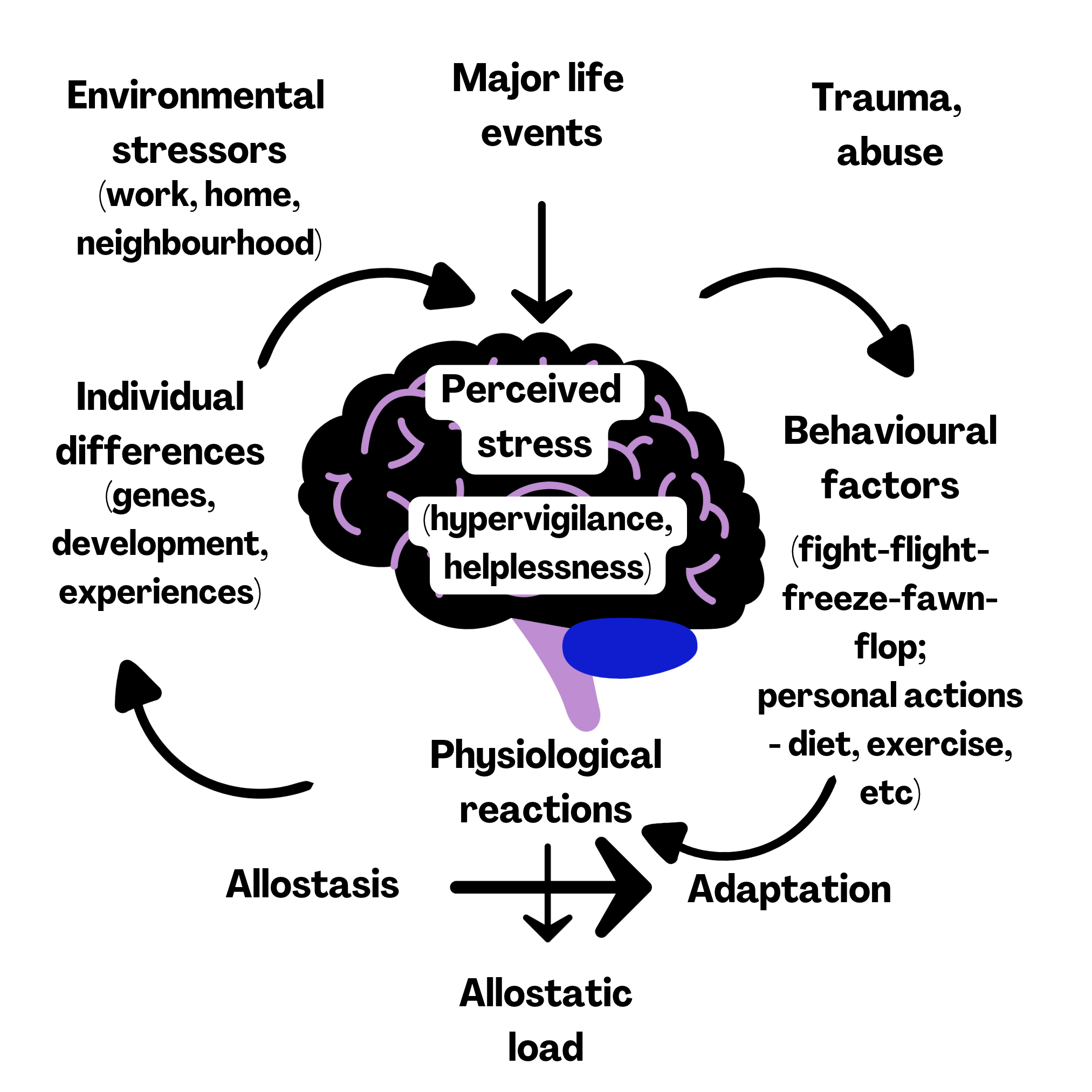
Figure 1: Visual representation of factors leading to allostatic load. Adapted from McEwen, B. S. (1998). “Protective and Damaging Effects of Stress Mediators.” New England Journal of Medicine.
When the mind perceives a stressor, psychological, physiological and behavioural reactions are initiated which can lead to allostasis and adaptation. Over time though, if allostatic load ensues, excess exposure to mediators of stress (e.g., neurological, immune) can have adverse effects across various organ systems, resulting in dis-ease.
Why so Much Discussion About Stress?
You may be asking yourself, “Why am I going into so much depth about stress in a discussion specifically related to mental disorders?” One main reason I am so passionate about this topic is that an extensive body of peer-reviewed research establishes a clear link between exposure to chronic or severe stress and a later clinical diagnosis of mental health disorders.
A seminal study using data from a large UK Biobank dataset looked at how highly stressful experiences during both childhood and adulthood compound over time (McManus et al., 2022). Evaluating brain imaging (MRI) data alongside cognitive tests, the researchers uncovered that:
A lifetime of exposure to stress was positively linked to a higher number of diagnosed mental health problems, with this effect being stronger in females than in males (McManus et al., 2022).
High levels of stress, whether experienced early in childhood or in adulthood, were tied to diminished executive function and working memory across both men and women (McManus et al., 2022); chronic stress seeming to make it harder for the brain to carry out tasks that require planning, focus, remembering instructions, and/or juggling multiple tasks.
A comprehensive molecular imaging review by Davis and colleagues (Davis et al., 2017) explicitly outlined how chronic stress can act as a catalyst for the onset of specific conditions like Bipolar Disorder, Major Depressive Disorder, and Post-Traumatic Stress Disorder. By synthesizing existing PET and SPECT data the researchers mapped how long-term stress affects neural chemistry to pave the way for major psychiatric illnesses, finding that chronic stress can:
Drain chemicals related to happiness and motivation - specifically serotonin and dopamine - while triggering neuroinflammation in specific regions also leading to a spike in glutamate, an excitatory neurotransmitter that can damage cells over time, all of which were related to Major Depressive Disorder (Davis et al., 2017) .
Lead to a drop in serotonin transporters, with stress sparking active inflammation in depressed states, within the hippocampus, a critical brain region for emotional processing and memory, these modifications observed in relation to Bipolar Disorder (Davis et al., 2017).
Multiply receptors responsible for the detection and handling of fear and anxiety indicating that as the brain constructs extra biological hardware to remain vigilant against threats, it can become locked in survival mode - a phenomenon observed in this study regarding Post-Traumatic Stress Disorder (Davis et al., 2017).
External Factors Contribute to Chronic Stress
When discussing chronic stress, it is therefore vital to explore the factors that contribute to it. There are a myriad of environmental, external contributors that do, such as:
Rising isolation, loneliness, and a lack of community.
Systemic inequalities and discrimination.
Work and education-related burnout, including excessive demands and little to no professional-life balance.
Diminished job security.
Financial strain.
Barriers to accessing quality healthcare.
Since External Changes Take Time, Look Inward
While these environmental factors must be addressed, they can take a great deal of time to change; therefore, what do individuals do when they are already “in the thick of it”?
Broad structural problems like work and corporate strain, misaligned medical systems, racism, and extreme educational pressures certainly require systemic solutions. However, when a person is right in the middle of a stressful, personal life and/or is just steeped within a stress-filled, outer world, and cannot immediately change their environment e.g., get a different job, move to a new neighbourhood, let alone fix deeply-ingrained societal structures overnight, they deserve practical alternatives to help them cope and perhaps even more crucially, to create and nurture fortitude, to generate and maintain health, well before stress magnifies.
This is where internally-sourced well-being, as I have decided to call it, becomes essential. While internal tools are not a cure for systemic issues, they act as physical and psychological buffers to protect our health even before stress strikes while we actively work toward broader external change.
Pausing For a Small Game
Imagine that I’m holding a glass of water. Can you guess around how much it might weigh? Take a few guesses.
...
Well, in actuality, the glass of water would only weigh as much as the length of time I continued to hang onto it. This is where letting go comes in. Surrendering, releasing, non-grasping (known as Aparigraha in Yoga), and practicing yielding, are forms of self-preservation. They can be extremely self-empowering, especially in a world that is already pervasively stressed.
“To let go is simply to release any images and emotions, grudges and fears, clingings and disappointments that bind our spirit.”
-Dr. Jake Kornfield
Perspectives stemming from Yoga-Informed Psychology, Yoga Chikitsa, and somatic psychotherapy highlight this view, offering a myriad of tools for letting go. Yoga Chikitsa in particular, acknowledges the importance of healing by nurturing our connections with others, our connection with the environment, but most foundationally, via our intrapersonal relationship with ourselves. It is through this latter bond that we can self-sustain and evolve through periods of greater strain and isolation, if and when necessary - which it typically is for so many.
Focusing on internally-sourced coping skills, like presence and deep relaxation, is loving-compassion in action - extensively rooted in ancient Eastern traditions such as Yoga, Yoga Chikitsa, and Yoga-Informed Psychology.
“Our relationship with ourselves is the blueprint for our relationships with others.”
-Dr. Harriet Lerner
Two Core Skills: Presence and Relaxation

While many internal skills can support well-being (like regular exercise), we can fundamentally build mental endurance and psychological capacity by strengthening presence and deep relaxation.
1. Presence (Psychological, Cognitive, Behavioural, and Somatic)
Psychologically, as emphasized in Acceptance and Commitment Therapy (ACT), presence involves cognitive and behavioral principles of remaining open to and detaching from unhelpful thoughts and emotions arising within (known as Vairagya in Yoga). It means being aware and anchored within the here-and-now, in tune with the observing part of ourselves-the witnessing consciousness, like the sky behind the weather (similar to Purusha in Yoga)-and choosing to consistently engage in committed actions that align with heartfelt core values (like Shraddha and Dharma in Yoga).
Physiologically, highlighted mostly in somatic and Yoga-informed psychology, presence involves learning the language of the body. This includes actively and regularly tapping into the body’s internal signals across biological systems such as:
Proprioception: Being aware of the body’s position, orientation, and balance in space.
Interception: Sensing and interpreting signals like the heartbeat, muscle tension, and breathing rate.
Kinesthestics: Noticing and being attentive to one’s own physical movements, weight, and degree of effort.
2. Deep Relaxation (Psychological, Cognitive, Behavioural, and Somatic)
True relaxation on these levels means moving the psychological, cognitive focus away from the analytical, problem-solving “hamster wheel” mind—which tends to wander into the future or ruminate on the past—allowing the mind to settle by releasing this heavy energetic processing. Behaviorally, it means dropping directives and intentionally choosing “being” over goal-driven, “doing-oriented” action. Somatically, relaxation resets the Autonomic Nervous System (ANS), deepening and expanding breathing, lowering heart rate, easing muscle tension, and overall, transitioning the body into a state of rest-and-digest and/or caring-connection.
A Shift From Pathogenesis to Salutogenesis
Most traditional mental health approaches focus on pathogenesis—examining how diseases develop so we can prevent them or treat the issue that has already arisen (like filling a dental cavity).
I think it is vital though, that we shift our attention and concentration toward salutogenesis—a term coined by Dr. Aaron Antonovsky which centres on promoting and maintaining ongoing well-being and overall health (like brushing your teeth so that they remain strong for as long as possible).
Pathogenesis = Actions done to avoid a negative health outcome like a cavity, usually involving treating the cavity only after it has already formed.
Salutogenesis = Daily, internally-sourced and chosen practices that develop into habits - like brushing your teeth a few times a day - to keep physical and psychological assets strong.
Practicing presence and relaxation (key word: Practicing!) regularly, works like weight training for the nervous system. It can broaden our Window of Tolerance—meaning the range within which we can manage higher levels of stress without crashing into hyperarousal or shutting down. These tools become what is known within the framework of salutogensis as health-related Generalized-Resistance Resources (GRRs), empowering people to find stability, resilience, meaning, and purpose even when the world outside remains chaotic.
“Yoga is Samatvam—equanimity. Mental health is not the absence of problems, but the ability to remain centred amidst success and failure, pleasure and pain, praise and criticism.”
-Dr. Ananda Balayogi Bhavanani
The Ripple Effect
By introducing these internally-sourced practices and tools earlier on - in schools, workplaces, and community centers - we redirect the paradigm from one of passive compliance and prevention of catastrophe (“I must practice these skills so that I don’t get sick”) to active health promotion centred on increasing mental endurance and capacity (“I want to use these skills because they help me flourish”).
“Putting the glass down” then, is a conscious, multi-faceted decision and inner skill we can practice. It is the psychological, cognitive, behavioral, and physiological act of firmly compelling and allowing our physical hardware to enter allostatic recovery. Taking the time to put our own glass down is neither selfish, nor does it undermine, minimize, or ignore the impact of external stressors. The positive changes, the presence, and the calm we can learn to cultivate and maintain within ourselves, naturally ripples outward—directly benefiting our families, our communities, and ultimately, the world at large, in ways we should not underestimate.
“Change yourself and you have done your part in changing the world.”
-Paramahansa Yogananda
References
Canadian Psychological Association. (2024). Psychology works fact sheet: Mental health and the workplace. https://cpa.ca
Lazarus, R. S., & Folkman, S. (1984). Stress, appraisal, and coping. Springer Publishing Company.
Lupien, S. S. (2019). To each their own stress (Par amour du stress). Éditions Vaillant.
McEwen, B. S., & Stellar, E. (1993). Stress and the individual: Mechanisms leading to disease. Archives of Internal Medicine, 153(18), 2093-2101. doi.org
Sterling, P., & Eyer, J. (1988). Allostasis: A new paradigm to explain arousal pathology. In S. Fisher & J. Reason (Eds.), Handbook of life stress, cognition and health (pp. 629–649). John Wiley & Sons
About Author
Dr. Kamala Pilgrim is a registered Clinical Psychologist (Ph.D., registered with the College of Psychologists of Ontario; #6285; Indian and Canadian yoga Alliances) with advanced training in Yoga, Yoga Chikitsa (therapy), Yoga-informed Psychology, and Somatic psychotherapies. She is a life-long yoga practitioner and ongoing yoga student, passionate about what spiritual tools such as asana (posture practice), meditation, sound healing, dance, music therapies and other creative arts, rooted in ancient wisdom traditions can contribute to modern psychology. Dr. Pilgrim offers teletherapy and therefore all interventions are carried out by her, online, for now.
